6/22/2006

Minnesota's achievement gap


Minnesota educators, policymakers, and teachers are wringing their hands over an Education Week report on the state's high school graduation rates. According to the Star Tribune:
Fewer than half of Minnesota's black high school students end up getting their high school diplomas, according to a new study by Education Week magazine. That's a graduation rate for black students that's one of the lowest in the country, further evidence that a big achievement gap exists between Minnesota's white students and students of color.

Predictably, liberals and progressives believe that this problem can and should be solved by government; specifically, raising taxes to fund massive expansions of early childhood programs and mandatory preschool, and redistributing wealth from rich to poor. They believe that society's ills can be fixed by government.

Conservatives, as Ronald Reagan said, believe that "Government is not a solution to our problem, government is the problem." They believe that society can and should be advanced through culture and values such as family and faith.

In 2004, Bill Cosby delivered a surprising, hard-hitting, and controversial take on the achievement gap on the 50th anniversary of the Brown v. Board of Education Supreme Court decision. It was a condemnation of the gangsta culture that pervades much of black society.
...Brown versus Board of Education: Where are we today? They paved the way, but what did we do with it? That white man, he's laughing. He's got to be laughing: 50 percent drop out, the rest of them are in prison.

Interestingly, the Education Week report does not include Minnesota race and ethnicity graduation rates for any group other than white and black. But it does list national data:

  • American Indian/Alaska Native (national): 47.4%

  • Asian Pacific Islander (national): 77.0%

  • Hispanic (national): 55.6%

  • Black (Minnesota/national): 43.6/51.6%

  • White (Minnesota/national): 83.1/76.2%

Why is the national Asian graduation rate higher than the rate for whites? Is it because more Asians are enrolled in preschool programs than whites? Do they receive better government programs than blacks? I would guess that the reason for this, and the reason that so many winners of academic competitions have eastern Indian, Chinese, and Korean family names, is that staying in school, learning English, getting a job, and delaying pregnancy are high priorities in those cultures.

Government may be part of the solution, after all the public schools are run by the government, but the achievement gap won't narrow dramatically until things change dramatically at home.

6/21/2006

EdWatch responds to Strib pro-IB editorial

The Strib recently savaged EdWatch for its stand on International Baccalaureate (IB). Here is EdWatch's response:
To the editor:

Your June 12 editorial countering EdWatch's criticisms of International Baccalaureate (IB) programs should have dug beneath the cheerleading to learn why the ranks of IB critics are growing.

For example, former IB student Liam Julian of the Fordham Foundation states, "Literary merit wasn't in the mind of those who created the reading lists in my IB English classes; multiculturalism and gender concerns were. ... Literature that had stood the test of time was sacrificed for contemporary works that addressed immediate cultural or feminist struggles."

IB standards are set in Geneva, Switzerland, and in some cases they are in direct conflict with Minnesota's new academic standards. IB states that it "promotes" the United Nations, while only teaching "appreciation" for our nation's founding documents.

One New York school district opposed IB because it competes directly with Advanced Placement classes, which are much more cost-effective and whose credits are accepted at the college level. Thousands of colleges do not give credit for individual IB classes.

Julie M. Quist, Chaska
Vice President, EdWatch

[I'm still working on my AP/IB post. As Mr. Strickland would say, "Slacker!"]

6/14/2006

Fordham gives Pawlenty's ed reform vision an "A"

Former Minnesota education commissioner Cheri Pierson Yecke broke a few eggs during her tenure in an attempt to make an education reform omelet, by implementing Gov. Tim Pawlenty's ambitious education reform agenda.

One of the hallmarks of Yecke's tenure was replacing the process-oriented Profile of Learning graduation standards with a new set of content-oriented academic standards in English, mathematics, social studies, and science. Yecke's standards creation process was transparent and rapid — the mirror image of the process used to create the Profile of Learning. The results satisfied the public's hunger for teaching both skills and knowledge, process and content, to Minnesota's public school students.

Last week, the Thomas B. Fordham Foundation awarded Minnesota's Academic Standards in World History with a grade of "A." The full text of the Fordham report, "The State of State World History Standards 2006," is available on the Fordham Foundation web site. The previous Profile of Learning standards earned a grade of "F" shortly before they were replaced by the current standards.

According to the report:
The recently approved and substantially improved Minnesota state standards begin by saying, "Public education in Minnesota must help students gain the knowledge and skills that are necessary to protect and maintain freedom." They aspire to specify "the particular knowledge and skills that Minnesota students will be required to learn." They suggest that the purpose of world history is to help students "recognize the common problems of all humankind, and the increasing interactions among nations and civilizations that have shaped much of human life." In that vein, they point out how the "increasing connections" make world history of critical importance "in fostering the respect and understanding required in a connected and interdependent world."

The revised standards deliver on much of this ambitious promise and will serve the current generation of Minnesota students well.

"Many Minnesotans devoted a great deal of hard work to these standards. They should all be proud about this excellent review of their work," current Minnesota Commissioner of Education Alice Seagren said in a press release. "Our current standards help Minnesota students understand the history that shapes their world, the traditions they have inherited, and the lessons of the past so they can meet the challenges of the future."

6/05/2006

Back to International Baccalaureate

Check out Norman Draper's fairly balanced article in the Star Tribune on International Baccalaureate, or IB. IB is a controversy coming to a school district near you. Just ask the folks at Minnetonka, who are emerging from a battle royale over IB (they adopted it in addition to Advanced Placement or AP), which may have been partially to blame for the resignation of one school board member.

Is IB anti-American or internationally-aware? Fuzzy touchy-feely or as one high school senior in Draper's article put it, "To me, AP is such a quantitative class...I think IB makes the conscious effort to go beyond the scholarship approach." Needlessly expensive or sound investment?

I am working on a longer post or possible newspaper op-ed piece in response to a local column that basically equated IB and AP as twin sons of different mothers. That may be a convenient shorthand for busy parents, but au contraire, mon frère, they are not the same.

5/18/2006

Integrated math: unloved, but is it working?


As announced in Scholar's Notebook last October, the Wayzata School District decided to conduct a random survey of Wayzata High School 2003 and 2004 graduates on their views on integrated math. The survey reveals that while integrated math is the math they love to hate, surprisingly, only 25% would end teaching integrated math to better prepare students for college, while 42% wouldn't change anything about how math is taught at WHS.

Wayzata is a high-achieving public school district in west suburban Minneapolis, Minnesota, whose peers are some of the other high-achieving public school districts, charter schools, and private schools in the state and country. Wayzata High School and its crosstown rivals Minnetonka, Robbinsdale Armstrong, Saint Louis Park, and Edina made Newsweek magazine's 1200 Best High Schools list this year, forming a public school golden crescent across the west metro.

Wayzata's integrated math curriculum

The Wayzata school district is a true-blue integrated math district. As they describe their math curriculum:
Fall 2005 is the eighth year that WHS is using the four-course Core-Plus Mathematics curriculum Contemporary Math in Context (CMIC). This is our only mathematics curriculum and we offer both a regular and an honors track. We are presently using UCSMP Everyday Mathematics in Wayzata?s elementary schools and the Connected Mathematics Project (CMP) in our middle schools.

Our implementation process involved starting with Core-Plus Mathematics Course 1 and adding the next course each year, while phasing out the sequential mathematics curriculum. Most WHS mathematics teachers have participated in at least one year of Core-Plus Mathematics implementation workshops and many have had multiple years of professional development.

In Fall 1997, WHS instituted a block schedule with four 86-minute classes per day. This schedule allows students to double-up on mathematics courses, if they desire. Therefore, some students complete four years of mathematics in less than four years of schooling.

The first graduating class of students who have studied Core-Plus Mathematics courses was the 2002 class.

In addition to these curricula, Wayzata students compete and place highly in math competitions from elementary school to high school.

Wayzata's integrated math program has been the focus of some parent concern. Parents are confronted with unfamiliar problem-solving algorithms, and the "spiraling" approach that revisits concepts during the year frustrates some. "Discovery learning" techniques don't work for students who don't discover the answers. The district said in its newsletter to residents, "school administrators believe [survey respondents' dislike of integrated math] reflects parent frustration at not being able to help their students with integrated math as well as they might have with traditional math." Some Wayzata grads told me that they took Advanced Placement math courses, or enrolled in the University of Minnesota Talented Youth Mathematics Program (UMTYMP) program to avoid integrated math.

Unloved

The survey sample size was 200: half from each graduating class (out of a total grades 9-12 enrollment of around 3000). Of these, over 80% were attending a four-year college or community college at the time of the survey. A similar percentage of this group is pursuing a bachelor of arts or bachelor of science degree. Over half of those surveyed (54%) attended Wayzata schools from kindergarten through high school.

As a group, Wayzata grads don't like integrated math:

What, if anything, did you like most about your mathematics classes at Wayzata High School?

Nothing, 45%
Teachers, 34%
Unsure, 6%
Calculus, 5%
College preparation, 5%
Other, 6%

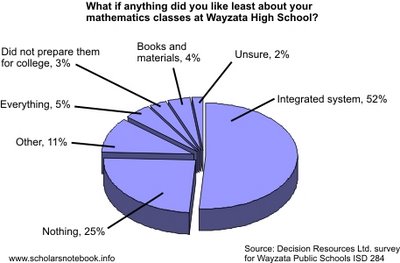
And what, if anything, did you like least about your mathematics classes at Wayzata High School?

Integrated system, 52%
Nothing, 25%
Other, 11%
Everything, 5%
Did not prepare them for college, 3%
Books and materials, 4%
Unsure, 2%


During high school, did you or your family pay for tutoring in mathematics outside of the school day, and separate from preparation for the ACT or SAT examinations?

No, 91%
Yes, 9%

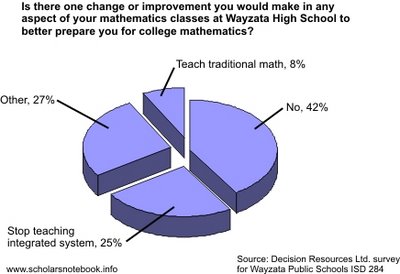
Is there one change or improvement you would make in any aspect of your mathematics classes at Wayzata High School to better prepare you for college mathematics?

No, 42%
Stop teaching integrated system, 25%
Teach traditional math, 8%
Other, 27%


How effective?

If 52% of those surveyed liked the integrated system the least about their math classes, why would 42% of them not change anything to better prepare themselves for college math? (Thirty-three percent said they would stop teaching integrated math or would teach traditional math, but even this group is smaller than the group who would change nothing.) Perhaps the answer lies in their college math experience, beginning with entrance exams:

As a first-year student, were you required to take any remedial or refresher classes in order to meet your school's entrance requirements? If yes, what remedial or refresher classes did you take?

No, 80%
Math, 15%
Science, 3%
Reading, 2%
Spanish, 1%

Once accepted, how well did Wayzata grads do on placement tests? Of those surveyed, 54% took a math placement test. These students were placed into math classes as follows:

Initial math class for chosen field, 52%
Remedial/refresher class, 24%
Advanced math class for chosen field, 20%
Don't know, refused to answer, 4%

What was your grade in your first college mathematics class?

A, 44%
B, 34%
C, 15%
D, 3%
F, 2%
Don't know, 2%

Do you regard your experience in that class as very successful, somewhat successful, not too successful, or not at all successful?

Very successful, 42%
Somewhat successful, 51%
Not too successful, 4%
Not at all successful, 3%

According to its newsletter to residents, "Wayzata intends to repeat this survey in two years, and again in five years."

Wayzata High School students have at least two other options for math education besides integrated math and outside tutoring. As a parent and taxpayer in the Wayzata district, I would have been interested in asking Wayzata grads these questions:

Did you take any Advanced Placement math classes while in high school? If so, which classes did you take? How large of a role did these Advanced Placement courses play, compared with your integrated math classes, in your success in college-level math classes (larger, smaller, or equal)?

Did you participate in the UMTYMP while in high school? If so, which classes did you take? How large of a role did these UMTYMP courses play, compared with your integrated math classes, in your success in college-level math classes (larger, smaller, or equal)?

I would be interested in hearing from more Wayzata grads on the results of this survey and their own experiences with integrated math.

For further information:

Curriculum alternatives to integrated math:


5/03/2006

Where's the math?

Clara Peller
A Washington state blog called Sound Politics is reporting, and its readers are commenting on, a group of Seattle parents concerned about math education. The group calls itself, "Where's the Math?" The name reminds me of that old Wendy's Hamburgers commercial, in which the late Clara Peller demands, "Where's the beef?"

Like similar Minnesota public school parent groups from Eden Prairie and Maple Grove, Where's the Math is questioning the radical "integrated math" education approach being promoted by math educators, but opposed by many mathematicians and college math professors. Their meeting in Bellevue, Washington last Tuesday, April 25 drew some 300 concerned parents, legislators, educators, college professors, and Elizabeth Carson, Director of New York City HOLD (a math advocacy group). Carson argued that math education is inferior in the United States compared to many other countries, and that it poses a threat to our national economy and security.

Where's the Math's story should sound familiar to Minnesota parents, check out my March 2005 archive for a refresher. Integrated math is widely, though not universally, taught in this state. Many parents are spending money on tutors, taking Advanced Placement math, or enrolling in the University of Minnesota Talented Youth Mathematics Program, at great expense and effort, to avoid integrated math curriculum such as the Connected Math Project. Others in the west metro have turned to homeschooling, or sought private schools, such as Providence Academy, or new charter schools such as Beacon Preparatory School, which use a proven sequential program, Saxon Math.

5/02/2006

Minnesota's coming universal preschool debate

Please run, do not walk, to listen in on this online debate over California's Proposition 82, Preschool for All.

Arguing in favor is Susanna Cooper, director of communications for Preschool California, one of the organizations pushing for approval of Proposition 82. Arguing against is Joanne Jacobs, one of America's most respected edubloggers.

Jacobs says:
Proposition 82 makes half-day preschool for four-year-olds an entitlement for all families, regardless of financial need and regardless of their children?s needs.

This form of universal preschool is more than middle-class kids need: Educated parents can prepare their children for kindergarten without professional assistance. The very slight preschool benefit for middle-class kids fades out by third grade.

Proposition 82?s universal preschool is much less than disadvantaged children need: The most effective programs for needy children start at earlier ages, run for a full day and include home visits to teach skills to parents.

Minnesota's own Ready4K is lobbying for pre-k entitlement programs as we speak, with a canard about half of all children being unprepared for kindergarten. California's Prop 82 debate is an echo and a preview of Minnesota's well-funded early childhood education and universal preschool sales pitches.

4/14/2006

Education Minnesota knows best(?)

The Education Minnesota teachers union's answer to rising health care costs in school districts would be a new state law (HF 517/SF 1459, passed by the Senate and pending in the House) that would require all school district employees, both union and non-union, to join a statewide insurance "pool."

The good news, according to the fiscal note prepared by the Department of Finance, is that some school districts will lower costs and improve health services. The bad news?
...other districts would likely experience increases in costs and/or poorer health care coverage. There will be a mixture of winners and losers. For districts, there will be pressure in contract negotiation to gain back coverage losses, or to access district cost savings in the form of salary or other increases.

My home school district, Wayzata, woud likely fall into the "losers" category under this legislation. Because the district saw this coming, its legislative platform includes this plank: "Continue to allow school districts to have local control and flexibility in designing health care plans that meet the needs of their employees." An optional pool would be OK, freeing districts to join or not depending on local circumstances. (I am a parent serving on Wayzata's LAC but obviously the opinions expressed here are my own.)

In related legislation, both HF 2833, the Omnibus State Government Finance Bill, and HF 4040, the Omnibus Education Finance Bill, contain language prohibiting school employees from using district funds or resources, including time, materials, equipment, facilities and communication technologies, among other resources, to advocate for electing or defeating a candidate, passing or defeating a ballot question, or passing or defeating pending legislation.

Legislative action committees of school districts have always been nonpartisan and stayed away from endorsing candidates for office, but where did the gag order on advocating for "passing or defeating pending legislation" (such as the mandatory insurance pool bills) come from?

This provision would force local school districts to defer to the teachers union's judgement on all legislation. I guess having its headquarters across the street from the Capitol isn't enough for Education Minnesota.

4/07/2006

Education Minnesota fails reality check


The million-dollar public relations campaign by the state teacher union Education Minnesota failed a reality check by Pat Kessler of WCCO-TV Channel 4 (and 100.3 KTLK-FM).

One of its TV ads features an older, white male politician (read: Republican) on the campaign trail, saying, "Minnesota schools have stood with the best for long enough. It's time to slash education spending and lower standards. Mediocrity, mediocrity, mediocrity."

Kessler responds, "In fact, Minnesota spent $6.6 billion on school last year. It will spend $6.9 billion this year...Educators complain because the state didn't keep up with inflation, they have to cut school budgets to make up the difference."

As to the inference of "mediocrity" during the Pawlenty administration, Kessler notes, "Minnesota ranks number 16 in the nation in money spent per pupil; number one in college ACT scores; and number one in high school graduation rates."

I don't expect this to show up as an example of "critical thinking" in your kid's mass communications class, but feel free to suggest it.

UPDATE: Mitch Berg of The Northern Alliance of Blogs linked to this post from Shot in the Dark, saying, "[Scholar's Notebook] is one of the better edublogs in the business, and an essential read on the subject." Thanks Mitch!

One of the commenters to Mitch's post on this topic provided a link to a related speech by Bill Gates, on February 26, 2005, to the National Education Summit on High Schools. In the speech, Gates lays out a grim picture of U.S. education relative to the rest of the world.

The failed promise of small learning communities


In marked contrast to its splashy announcements of large grants (totaling $1 billion) to fund some 1500 "small learning communities" across the country, the Bill and Melinda Gates Foundation has quietly concluded: they don't work.
"At the Gates Foundation, early grants went to utopian and communitarian movements but we moved away from that because it does not work," foundation spokesman David Ferrero said late last month. Ferrero spoke at a conference on high school reform sponsored by the Center for Education at the National Academies of Science. (from "Educational Epiphany of Bill Gates" by Malcolm A. Kline, April 05, 2006)

Tom Vander Ark, executive director of the Bill and Melinda Gates Foundation's education initiatives discovered, "With many of our early grants, I encouraged people to fix the architecture. Several years later, many of those same folks are stuck in architectural arguments and never got to the heart of the issue — teaching and learning."

In his January 2006 commentary in Education Week, "Come Clean on Small Schools" (requires registration) David C. Bloomfield, professor and the head of the educational leadership program at the Brooklyn College campus of the City University of New York said, "The students affected do not have the luxury of walking away from failed social experiments."

If you are a parent, this last comment should hit home. If your school district adopts the latest educational fad, ask lots of questions. The foundation grant money may sound sweet to cash-strapped schools, but your child does not have the luxury of a "do over" if it does not work for him or her.