8/30/2005

Farewell to Cheri Pierson Yecke

Cheri Pierson Yecke, 2004 (Photo: NARN)As one of Cheri Pierson Yecke's appointees to the Academic Standards Committee for Social Studies, I had the rare privilege and opportunity to work with and get to know Minnesota's former Commissioner of Education. She led her department through a stormy period of change and innovation with vision, courage, and grace, and was rewarded for her efforts with some of the most hateful personal attacks in recent memory, topped with an ingnominous late-night termination of her employment by the DFL-led Minnesota Senate.

As Yecke assumes her new post as head of the Florida Department of Education, may I be among the first to congratulate Floridians on their new Chancellor. I encourage them to look forward to greatness from their public schools, and to strong leadership that puts the academic growth of students above all, even above politics.

King Banaian said it well:
I am saddened, too, on a personal level, as I have come to know Cheri as a delightful and energetic mind with both wit and grace and conviction. She is not bashful about what she believes, and her forcefulness probably pushed a few people who might have supported her into quiescence due to the force of the people who attacked her. I know a few lefty bloggers who will be happy to help her pack her bags, along with the leadership of Education Minne$ota. She has that effect on people. But the woman was not for turning, as Margaret Thatcher said.

See Republican Minnesota for the complete scoop (apparently they got the story first). Great scoop, RM.

8/26/2005

My State Fair photoblog

Unlike today, Day 1 of the The Great Minnesota Get-Together occurred under perfect weather conditions. Here is how Scholar's PDA cam saw the day:

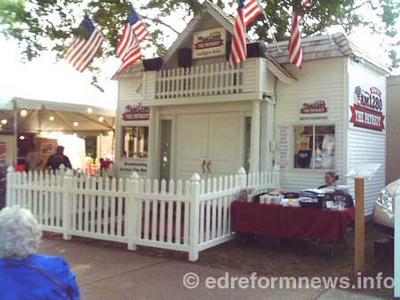
The AM 1280 The Patriot booth, H18 Judson Avenue, with merchandise table and remote studio:
© edreformnews.info

Look for national remote broadcasts next week, and weekend remote broadcasts from the Northern Alliance Radio Network and Taxpayers League Live. Stay tuned to The Patriot for details.

My camera was malfunctioning, otherwise here would be a photo of the Air America booth, south side of the fairgrounds, which consisted of a table under a tent.

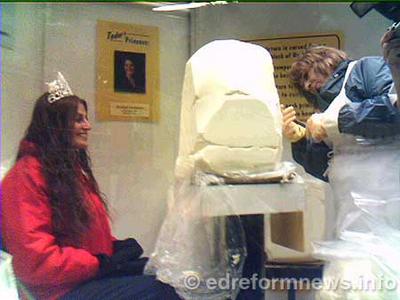
Princess Kay of the Milky Way 2005, the lovely tiara'ed Rebekah Dammann of Lester Prairie, poses for her traditional butter head sculpture by sculptor Linda Christensen in the 38 degrees F cooler of the Empire Commons Building (the "dairy building"):
© edreformnews.info

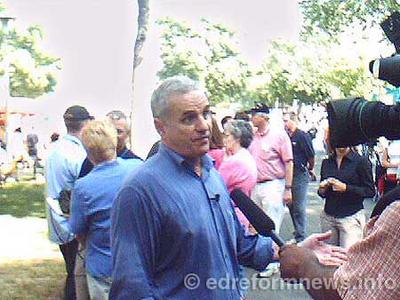
Sen. Mark Dayton conducted a non-political photo-op with a half-dozen representatives of Operation Minnesota Nice. Bravo, Sen. Dayton:
© edreformnews.info

Other brushes with fame: Minnesota Department of Education Commissioner Alice Seagren, in her department's booth in the Education Building; K-102 disk jockey John Hines; TPT political reporter Eric Escola, at the Dayton appearance.

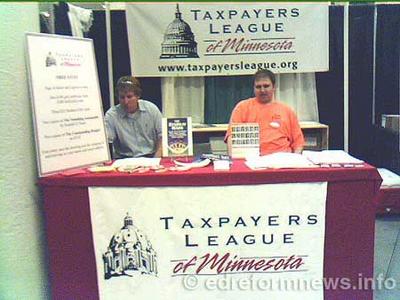
As 3:00 pm approached, I reported for volunteer duty at The Taxpayers League of Minnesota booth. That's Bill, a Taxpayers League staffer, and a fellow volunteer:
© edreformnews.info

The booth is located on the first floor of the Grandstand, next to the United States Postal Service booth, and across the isle from a watches/dog tags/trinkets booth, staffed by a jovial guy with a huge plastic insulated coffee mug. The Grandstand is truly a showcase for free market enterprise and the marketplace of ideas.
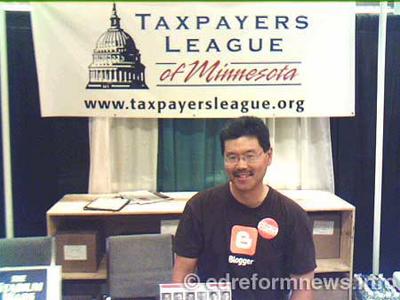
© edreformnews.info

The highlight of my three-hour shift was an encounter with a self-described professor of physics at the University of California, Berkeley. He was apparently in his 60s age-wise, and in the 1960s, ideologically. He had long white hair, scraggly beard, and two-inch fingernails that curled into claws. He wore a stained wide-brimmed hat, and had a faint scent of Berkeley about him. The professor strode up to the booth, and began by stating that The Taxpayers League was responsible for the last two years of the decline of the state of Minnesota, and thank goodness Tim Pawlenty had the courage to break his No New Taxes pledge this legislative session. He continued for five or ten minutes. At first I began preparing a response to his opening salvo, but soon I realized that this was not a debate, it was a lecture.

The professor ranted nonstop on a wide-ranging litany of liberal talking points, passionate but not hostile toward me personally, that included these topics:

  • No New Taxes Pledge (he was agin' it)
  • Ever-increasing "investment" in higher education (he was for it)
  • The decline of the once mighty research institutions at Big Ten universities like Minnesota, Iowa, and Wisconsin due to a lack of "investment" by the states
  • The looming engineer shortage
  • The purchase of American automobile and home appliance companies by China
  • The recruiting of PhD graduates by the Chinese
  • Near envy of the "efficiency" of the Chinese totalitarian regime
  • President Bush's "war for oil"
  • Blamed Enron for the California energy crisis (during which the state of California imposed retail price controls on energy, and after which Californians elected a Republican governor)
  • Global warming ("It's a fact," said the professor)
Stop by the booth and say, "hi!" You might see David Strom there this weekend. Please be nice to the volunteers!

The Libertarian Party of Minnesota and Constitution Party of Minnesota both have booths in the Grandstand. The Republican Party of Minnesota is where it has always been, on Carnes Avenue near Ye Olde Mill and WCCO Radio. They are giving away tiny buttons that say "I [heart] America, It's Taxes I Hate." But what about "fees?"

Best new food: Blueberry malts, made with a heaping spoonful of frozen blueberries on top that you stir into the plain malt yourself, at Empire Commons. Mmmmm.

Have fun at The Fair!

8/24/2005

Scholar's State Fair Checklist

It's late August, when a young owl's fancy turns to...The State Fair! The Minnesota State Fair starts tomorrow. Scholar loves the fair, it has his favorite things in life: food, education, politics, talk radio, and lots of free stuff (what my friend who sells specialty advertising calls "trinkets 'n' trash"). So here is this year's edition of the clip-and-save (or cut-and-paste) Scholar's State Fair Checklist!

1. Education Building

  • Minnesota State Legislature - get yer Red Book directory of legislators and other fascinating and practical literature without having to visit the nice ladies at 175 State Office Building, and maybe meet a state legislator in person.

  • Minnesota Department of Education - free pencils! And speak with someone who knows the difference between Q-Comp and Q-Tips.

  • Minnesota Department of Commerce - free CD-ROMs loaded with consumer info!

  • Education Minnesota - free union propaganda!

  • William Mitchell School of Law - free pocket U.S. Constitution booklets (grab some for the kids)!

  • Bethel University - free rulers!
2. Media

  • AM 1280 The Patriot - when you've said The Patriot, you've said it all. Check out the Northern Alliance Radio Network broadcasts on the weekends. Get a photo of the guys eating Scotch eggs. Southeast corner of the fairgrounds, on Judson Avenue near the International Bazaar (there's a joke in there somewhere).
3. Politics

  • Taxpayers League of Minnesota - first floor, Grandstand. Get yer static clings, brochures, and less taxes, smaller government dogma! Meet David Strom (maybe)!

  • Political parties

  • Political candidates
4. Food

  • Tom Thumb Doughnuts and dark roast coffee

  • Pronto Pups

  • Sweet Martha's Chocolate Chip Cookies

  • Dino's Gyros

  • 1000 ml Nalgene bottle of water from home, frozen the night before if I remember

  • Guilty pleasure: Cheese Curds
Have fun at The Fair! After The Fair ends, boom, it's back to school.

8/23/2005

Edubabble

As a writer, I am always looking for new and interesting uses of the language. When humor is involved, so much the better. Here is one of those random jargon generators that picks a phrase from each of three columns to create a new edubabble phrase. Some examples:

  • target holistic life-long learning

  • deliver meaning-centered goals

  • aggregate collaborative critical thinking
(Hat tip to Instructivist, with a half-hat tip to King Banaian at SCSU Scholars for a related post.)

On second thought, maybe these aren't so funny. They sound like they could come from my kids' curriculum night programs.

Here are some others that are funny:


8/19/2005

Back to school

Scholar's favorite topics — education policy, curriculum & instruction, and social studies — will be discussed after Labor Day at the following public forums. Get one or both on your calendar now, and maybe you'll see Scholar there.

"What Should Schools Teach About the U.S. Constitution?"
Dr. John Eidsmoe, constitutional attorney and professor, Thomas Goode Jones School of Law at Faulkner University, author
Saturday, September 17, 2005 (6:30 pm, registration; 7:00 pm, event)
Grace Church, 9301 Eden Prairie Road, Eden Prairie, MN 55347
Sponsor: EdWatch
Cost: $15 per person. Dessert and refreshments provided. CEU's available for teacher credit.
Reservations due by September 8, 2005
For further information: Phone 952-361-4931

Congress has declared that "educational institutions receiving Federal funding are required to hold an educational program pertaining to the United States Constitution on September 17 of each year." What will students at your local school be learning each year on that day? That the U.S. Constitution means whatever the Supreme Court Justices say it means? Or does the Constitution represent principles that endure regardless of judges or administrations?

10 points to the first person who can say why Congress chose September 17th for this day. Claim your points in the comments.


"A Patriot's History of the United States: How Academic Bias Distorts America's Past"
Larry Schweikart, professor of history, University of Dayton, author
Thursday, September 22, 2005 (7:00 pm)
Providence Academy, 15100 Schmidt Lake Road, Plymouth, MN 55446
Sponsor: Center of the American Experiment
Cost: Prepaid reservations are only $5 if received by September 12 and $10 afterwards or at the door. Tours of Providence Academy will be available following Professor Schweikart's presentation.
For further information: Phone 612-338-3605.

Larry Schweikart, author of A Patriot's History of the United States and professor of history at the University of Dayton, will examine historians' deceptions regarding the Reagan years, focusing on the "deficits" myth and "The Speech that Won a War," the famous 1983 "Star Wars" speech that revealed to the USSR that it could not win the Cold War.

8/16/2005

Whither Q-Comp?


Tomorrow, a family friend who recently began his tenure as principal of a charter school is attending the Minnesota Department of Education First Annual Q-Comp Conference. I'll be interested in his impressions of the day.

Education reformers had high hopes for Governor Tim Pawlenty's Q-Comp proposal. Short for "Quality Compensation," the reform was designed to move teachers away from the current "steps-and-lanes" system that rewards teachers simply for longevity and additional education. The reform would have tied teacher compensation more closely to student performance.

Craig Westover has done a number of detailed analyses of what Q-Comp was supposed to be, and what finally passed the Legislature. He even did an extensive fisking of Education Commissioner Alice Seagren's defense of the final bill (in a line-by-line analysis of the final legislation). Westover maintains that not much changed, and the student performance measures were significantly weakened or eliminated.

Folks, we did not get a restructured compensation system. We did not get a merit pay system based on student achievement. We did not get education reform. We got a career advancement subsidy that puts process (improving skills) ahead of results (student learning). The only criterion of student performance — standardized state tests — is optional.

Our favorite econ prof, King Banaian, provided his insights on this topic right after the special session adjourned:

The problem is, once again, the misunderstanding that labor competes with labor and firms or school districts compete with other firms or school districts. It is this part, and this alone, that convinces me Craig is right. A union is a cartel; it acts to restrain competition among laborers within a firm (and often those outside). A merit pay system by its very nature encourages competition among teachers.

A teachers' union which wanted to show its professionalism and its concern for students would allow competition among teachers. But for a union, that's an argument against interest. The answer, of course, is real school choice.

Sunday's Star Tribune OpEx section devoted a large amount of black ink to the subject. You would do well to fish it out of the recycling or click these links for a second look:

Our friend Rep. Mark Buesgens (R-Jordan) put it this way, "in the end, the champions of the status quo won."

Sen. Steve Kelley (DFL-Hopkins) is taking a moderate-sounding stance, saying, "The collaborative design of Minnesota's new alternative teacher pay guidelines has the potential to significantly improve the way educators are paid."

Education Minnesota President Judy Schaubach says that schools will need more money and more time (a frequent teacher union response to reform), and "a new pay system should be based on student needs — not ideology." Fair enough, but calling needed reform "ideology" is a favorite tactic of the keepers of the status quo.

Refreshingly, the Star Tribune editorial on Q-Comp provided a downright favorable review of teacher pay reform in general, and what passed as Q-Comp specifically:

The steps-and-lanes pay structure has long needed a makeover. Earning more solely because of seniority and additional degrees had its place when the system was developed, but contemporary teaching and learning needs call for a different design...

The Q-Comp experiment will produce a wide range of compensation plans — quite possibly including as many misses as hits. As the models are tried, Minnesota should take the best of them to build a system that improves student learning and does a better job of recruiting, retaining and rewarding teachers.

Over time, Q-Comp will mean whatever individual proposals and school districts (and perhaps future legislation) say it means. Q-Comp 2005 wasn't everything we hoped it would be, but at least teacher pay reform in Minnesota is now off to a start.

8/09/2005

Like frogs boiling

The good citizens of the Third District apparently believe that education is a function of local and state governments, not the feds, according to a constituent survey conducted by Rep. Jim Ramstad's office:

Do you support the President's proposal to expand the federal testing mandates of "No Child Left Behind" to public high schools?

YES: 40%
NO: 60%

According to the U.S. Department of Education:

The president's 2006 [budget] request includes a comprehensive proposal that builds on the stronger accountability provisions of the No Child Left Behind Act to improve the quality of secondary education and ensure that every student not only graduates from high school, but graduates prepared to enter college or the workforce with the skills to succeed.

The president's budget provides nearly $1.5 billion for this High School Initiative, and includes $1.24 billion for a High School Intervention initiative that would focus on strengthening high school education and providing specific interventions. The president's high school program also includes $250 million to help states develop and implement new annual High School Assessments in reading/language arts and mathematics by the 2009-10 school year.

My friend Cheri Pierson Yecke would presumably go along with this expansion of NCLB, but this talk of pouring billions of new federal money into education takes me back to a conversation I had with a buddy over at Famous Dave's before the 2000 elections. We were talking about candidate George W. Bush, and how his state's education policies seemed to mirror Bill Clinton's (centralized, top-down accountability, vocational slant rather than localized and knowledge-based). Our heartburn that evening didn't come from the barbecue, and with good reason. According to the Department of Education, President Bush has opened the federal money spigot since signing NCLB into law (with a corresponding loss of local control):

  • An $8 billion, or 46 percent, increase for No Child Left Behind programs

  • A $10.3 billion increase in overall funding for federal elementary and secondary education programs

  • An increase of $4.6 billion, or 52 percent, for Title I Grants for economically disadvantaged students

  • A $4.8 billion, or 75 percent, increase for grants to states under the Individuals with Disabilities Education Act (IDEA) Part B [also known as "special education"]
Like frogs in water slowly brought to a boil, we are headed for a nationalized public education system without realizing it. This causes conservatives more than a little heartburn, but what are we going to do, vote for Hillary? Remember School-to-Work??

8/08/2005

Making an increase look like a decrease

When Republican foes at the Star Tribune are faced with the Legislature's historic increase in K-12 spending for the upcoming biennium, they make it look like a decrease in spending:

If education is what matters most, then Minnesotans should take care to sort the spin from the facts about the 2005 Legislature's education investment. The increase in K-12 funding is being sold as the biggest in more than a decade -- and in nominal dollars, it is. But that claim relies on a combination of state and local dollars, and does not take inflation and enrollment change into account. Considering just state spending and comparing inflation-adjusted dollars per capita, Minnesota's K-12 investment in the new biennium will decline 1.4 percent from the previous one.

First, all dollars are taxpayer dollars, whether they come from the state or local property taxes. State taxes are not a "more legitimate" source of education revenue than local taxes, unless Robin Hood is your model. Second, per capita spending is a fallacious way to measure education spending, unless you're desperate to spin an increase into a decrease. The Republican Party of Minnesota clarified the situation in its e-mail newsletter last week:

According to the U.S. Census Bureau, Minnesota's population has grown steadily over the last ten years, and from 2000 to 2004, it grew 3.69 percent.

However, K-12 enrollment in Minnesota's schools has declined. According to Minnesota Department of Education figures, from the 2000-2001 school year to the 2004-2005 school year, enrollment in Minnesota's schools decreased 1.86 percent.

So the population serviced by K-12 education funding is decreasing, and the Star Tribune Editorial Board wants to measure it by an entirely different set of figures that is increasing.

Here's the real facts: In the 2006-2007 biennium, per pupil education funding increased 7.8 percent and school districts could receive even more if they use QComp or performance pay incentives.
