Another academic bull has been kicked out of Minnesota's K-12 china shop.
The Minneapolis school board accepted the resignation of Superintendent Thandiwe Peebles, who simultaneously raised test scores, assigned homework over Christmas (sorry, "winter") vacation, rankled educators, snubbed politicians, allegedly used district resources for personal gain, and according to a Star Tribune report, failed to touch "the right bases downtown."
"In the end you fail because the politics causes you to fail," said Charlie Kyte, a former superintendent and head of the Minnesota Association of School Administrators, in the Strib story. "There really is a conflict here," Kyte continued, "between the real users of the Minneapolis public schools, which is a whole set of communities of color, and the established old-guard liberals who are primarily white ... The adult drama needs to come to an end, and everyone needs to refocus on education and achievement."
That's all well and good, but focusing on education and achievement can get you fired. Just ask Dave Jennings, Thandiwe Peebles and Cheri Pierson Yecke.
EDUCATION
1/30/2006
1/25/2006
A charter school is (re)born
Regular Scholar's Notebook readers will recall last year's story of Veritas Academy, a fledgling charter school that due to various circumstances never opened its doors.
I am happy to report that Veritas Academy is now Beacon Preparatory School, which will be open in Plymouth, Minnesota in the fall of 2006 for sixth grade, sixth and seventh in 2007, and adding grade eight in 2008. The school has the same sponsor as the former Veritas Academy, Friends of Ascension. In fact, Friends of Ascension is also the sponsor of Beacon Academy, a K-5 charter school that will share space with Beacon Prep.
The mission of the Friends of Ascension is "to improve the education of children." They began by starting Ascension School in north Minneapolis with traditional math and Core Knowledge curricula. Their results fly in the face of public schools that whine about demographics. Where Ascension School is located, 31.7% of the families with minor children have incomes below the poverty level, and 76.7% of the population is minority (the largest groups are African-American, 51.2%, and Asian, 17.9%).
In 1999, before Friends of Ascension implemented the Saxon math program in the school, Ascension grade school performed at a 21% pass rate on the Minnesota mathematics standardized achievement tests. In 2000, Ascension School achieved an 80% pass rate on both the Basic Skills mathematics test and the reading test. In 2005, the students achieved a 90% pass rate on the math test and a 95% pass rate on the reading test.
According to the group, "Due to the tremendous success achieved at Ascension School with the Core Knowledge sequence and Saxon math, Friends of Ascension sponsors only those charter schools which implement the Core Knowledge sequence in grades K-8 and a similar classic content-rich curriculum in grades 9-12. Friends of Ascension also requires that its sponsored schools implement a phonics-based reading program and a sequential math curriculum typified by the Saxon math program."
Friends of Ascension is apparently determined to duplicate its successes across the state. The non-profit group now sponsors over a dozen Minnesota charter schools now in operation or in the planning stages, including Beacon Preparatory School.
Beacon Prep's association with Beacon Academy gives the school some significant advantages:
EDUCATION, CHARTER SCHOOLS
I am happy to report that Veritas Academy is now Beacon Preparatory School, which will be open in Plymouth, Minnesota in the fall of 2006 for sixth grade, sixth and seventh in 2007, and adding grade eight in 2008. The school has the same sponsor as the former Veritas Academy, Friends of Ascension. In fact, Friends of Ascension is also the sponsor of Beacon Academy, a K-5 charter school that will share space with Beacon Prep.
The mission of the Friends of Ascension is "to improve the education of children." They began by starting Ascension School in north Minneapolis with traditional math and Core Knowledge curricula. Their results fly in the face of public schools that whine about demographics. Where Ascension School is located, 31.7% of the families with minor children have incomes below the poverty level, and 76.7% of the population is minority (the largest groups are African-American, 51.2%, and Asian, 17.9%).
In 1999, before Friends of Ascension implemented the Saxon math program in the school, Ascension grade school performed at a 21% pass rate on the Minnesota mathematics standardized achievement tests. In 2000, Ascension School achieved an 80% pass rate on both the Basic Skills mathematics test and the reading test. In 2005, the students achieved a 90% pass rate on the math test and a 95% pass rate on the reading test.
According to the group, "Due to the tremendous success achieved at Ascension School with the Core Knowledge sequence and Saxon math, Friends of Ascension sponsors only those charter schools which implement the Core Knowledge sequence in grades K-8 and a similar classic content-rich curriculum in grades 9-12. Friends of Ascension also requires that its sponsored schools implement a phonics-based reading program and a sequential math curriculum typified by the Saxon math program."
Friends of Ascension is apparently determined to duplicate its successes across the state. The non-profit group now sponsors over a dozen Minnesota charter schools now in operation or in the planning stages, including Beacon Preparatory School.
Beacon Prep's association with Beacon Academy gives the school some significant advantages:
- Beacon Prep's start-up coordinator is Beacon Academy's current principal/director, Jordan Ford, an experienced educator and administrator.
- Beacon Prep's board of directors include current Beacon Academy parents and the mayor of nearby Medicine Lake, Mary Anne Young.
- Beacon Prep will be housed in the same building as Beacon Academy, a renovated former Wayzata Public Schools building on a hillside with over five acres.
EDUCATION, CHARTER SCHOOLS

1/18/2006
Stossel challenges the American education establishment
John Stossel gets an "A" for taking a hard look at the failures and successes of K-12 education in America in his 20/20 program, "Stupid in America." Visit the companion web site for a report that partially follows the TV script, a link to purchase the report on video and its transcript, and a huge Stossel message board, and more.
Stossel tackles these hot-button topics in education reform:
The show has generated quite the buzz in the blogosphere:
Don't miss the related post and comments over at fellow MOBster Prof. King Banaian's SCSU Scholars.
Education-related bloggers check in at the current Carnival of Education over at the Education Wonks.
Google Blogsearch: john stossel stupid in america
EDUCATION
Stossel tackles these hot-button topics in education reform:
- Funding — "National graduation rates and achievement scores are flat, while spending on education has increased more than 100 percent since 1971. More money hasn't helped American kids."
- Choice — "In Belgium, by contrast, the money is attached to the kids — it's a kind of voucher system. Government funds education — at many different kinds of schools — but if a school can't attract students, it goes out of business...'That's normal in Western Europe,' Harvard economist Caroline Hoxby told me. 'If schools don't perform well, a parent would never be trapped in that school in the same way you could be trapped in the U.S.'"
- Unions — "...in New York City these problem teachers are made to sit in the 'rubber room' which are rooms where they go by day to sit and read books and magazines, rather than to teach. The school not only pays their salary and keeps them employed but they pay $20 million per year to rent four different buildings to house these teachers. There are 80,000 teachers in New York City and they said only two have ever been fired due to having just cause. A flow chart of the disciplinary process for teachers was shown and it unfolded it seemed to go on and on, with many pages, with a complicated flow chart process! (from Christine at The Thinking Mother)
The show has generated quite the buzz in the blogosphere:
Don't miss the related post and comments over at fellow MOBster Prof. King Banaian's SCSU Scholars.
Education-related bloggers check in at the current Carnival of Education over at the Education Wonks.
Google Blogsearch: john stossel stupid in america
EDUCATION
1/16/2006
The federalization of education

Diane Ravitch, author of the education reform classics The Language Police
 and Left Back: A Century of Failed School Reforms, is advocating national standards as a way to hold states more accountable for student achievement. She says that standards based on the National Assessment of Educational Progress (NAEP) are the next logical step in the standards-based reform that began with Goals 2000 and No Child Left Behind.
It seems time for conservative watchdog groups like EdWatch to say, "I told you so." When EdWatch began fighting The Profile of Learning back in the 1990s, they were warning against the federalization of education.
After the Minnesota Legislature repealed the fuzzy process-based disaster called The Profile of Learning, Gov. Tim Pawlenty charged his new education commissioner Cheri Pierson Yecke with developing new state academic standards in their place. As a member of Yecke's Social Studies Academic Standards Committee, I witnessed first-hand the good, the bad, and the ugly of standards setting at the state level. Good and bad, the process nevertheless was probably the most open and transparent in state history, with open meeting laws enforced, statewide public hearings, a Department of Education web site, and a then-new medium called blogs exposing the process for the world to see. Warts and all, it was a public process, a Minnesota process.
I would have very little faith in the U.S. Department of Education, Department of Labor, or any other federal agency charged with porting the NAEP into national academic standards, to conduct a national standards creation process with such transparency (setting aside the dubious merit of basing standards on the NAEP at all). The federal bureaucracy and education establishment would write the nation's standards, as they wrote the NAEP, with little or no citizen and parent input or feedback.
The states and local school districts, not to mention students and parents, would hand over an enormous amount of accountability to the feds in return for very little funding (in Minnesota, the federal government accounts for about 7% of education funding). A national curriculum would naturally follow national standards. School boards and state legislatures would be reduced to picking out paint and carpet colors, while keeping the bulk of the burden for funding and fulfilling a raft of underfunded mandates.
Conservatives have warned for years against the federalization of education. First of all, the states, not the federal government, are constitutionally responsible for education. Check out your state's constitution. Minnesota's says: "The stability of a republican form of government depending mainly upon the intelligence of the people, it is the duty of the legislature to establish a general and uniform system of public schools. The legislature shall make such provisions by taxation or otherwise as will secure a thorough and efficient system of public schools throughout the state."
By its silence on education, the Tenth Amendment to the federal constitution defers to the states: "The powers not delegated to the United States by the Constitution, nor prohibited by it to the States, are reserved to the States respectively, or to the people."
Presidents have also warned against the federalization of education:
Diffusion of authority among tens of thousands of school districts is a safeguard against centralized control and abuse of the educational system that must be maintained. —Dwight D. Eisenhower, New York Herald Tribune, February 9, 1955
I believe this [the National Education Association proposal for a federal education system] is the road to disaster and the end of academic freedom. —Ronald Reagan, Los Angeles Times, February 5, 1976
If you want to improve academic achievement in America, we don't need another failed reform by a bigger U.S. Department of Education, we need to get rid of this Jimmy Carter-era, 4,500-employee, $71.5 billion bureaucracy, restore to the states full control of their constitutional mandate for K-12 education, and let the funding follow the child.
EDUCATION
1/13/2006
Stupid in America
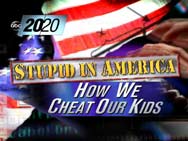 Stupid in America: How U.S. Public Schools are Failing Kids is the latest report from our favorite network news reporter, John Stossel.
From the ABC News web site:
There are many factors that contribute to failure in school. A major factor, Stossel finds, is the government's monopoly over the school system. Parents don't get to choose where to send their children. In other countries, choice brings competition, and competition improves performance.
Stossel questions government officials, union leaders, parents and students and learns some surprising things about what's happening in U.S. schools. He also examines how the educational system can be improved upon and reports on innovative programs across the country.
"Stupid In America: How We Cheat Our Kids" with John Stossel airs Jan. 13, at 10 p.m. EST, except in the Twin Cities, where it airs on Jan. 14 at 12:35 a.m. (that's after midnight tonight, not tomorrow afternoon), KSTP-TV Channel 5, because of the Minnesota Timberwolves broadcast. Set your VCRs.
It's well worth noting that Minnesota is a national leader in school choice, with charter schools (they were invented here), open enrollment (students are free to enroll outside their district; 30,000 Minnesota students did so in 2004-05), online learning, homeschools, post-secondary enrollment options (PSEO), and more. Stossel should visit Minnesota for a follow-up (but look for Minnesotan Pam von Gorhen in tonight's report).
Hat tip to Craig Westover, Mr. School Choice.
EDUCATION
1/10/2006
Top education reform news of 2005
Here are Scholar's picks for the top education reform news of the past year, with a preview of their implications for the year to come:
- K-12 funding - the Minnesota Legislature approved the largest increase in more than a decade for K-12 education, $800 million total new revenues. Of that total, $139 million is from board-authorized and voter-approved levies. This represents a 4 percent increase each year of the biennium, raising the per-pupil basic formula to $4,783 in FY 2006 and $4,974 in FY 2007. With funding defined for 2006-2007, funding should be a lower priority this session, but Governor Pawlenty had the audacity this week to suggest that 70% of a district's budget should be spent in the classroom (more on this later).
- Referendum cap - raised to 26 percent of the formula allowance. A perennial point of debate between property-rich and property-poor districts, even with equity aid going to the latter. Gives districts more freedom to ask its voters for excess levies.
- Q Comp - A total of $86 million for Quality Compensation (Q Comp), Minnesota's version of Teacher Advancement Program (TAP). To date, seven school districts and two charter schools have been awarded Q Comp funds:
- Minneapolis, $1.2 million
- Hopkins, $2.1 million
- St. Francis, $1.5 million
- Mounds View, $2.7 million
- St. Cloud, $2.5 million
- Northfield School of Arts and Technology (ARTech), $24,180
- Duluth Public Schools Academy (DPSA), $200,720
- Alexandria, $1.1 million
- Fridley, $656,240
- Early Childhood - $5.2 million increase for ECFE, $1.2 million increase for health screening, and $4 million increase for Head Start. Early childhood education provider interest group Ready4$, I mean Ready4K, and the "public-private" nonprofit Minnesota Early Learning Foundation (MELF) will be lobbying for more state money to get kids ready for kindergarten (I thought kindergarten was supposed to get kids ready for first grade). What's next, "universal preschool" or "mandatory age 0-4" programs? Scholar would prefer to leave the preschool choice to parents, and to target pre-K dollars to specific children truly needing extra help to succeed.
I think you have to start somewhere to step away from steps-and-lanes, but Craig Westover says that school choice is the ultimate answer: "Feeling that programs like Q Comp will significantly improve public education is delusional. Until all schools are challenged by families, regardless of income, seeking out the best schools for their children, we are merely feeding the beast — with our tax dollars and the futures of our children." I am not so delusional as to think that Q Comp 1.0 is perfect, but now that we have it, and its integrity is being protected by Alice Seagren's Department of Education, let's win some elections and tune it up in the next legislative sessions.
- Curriculum & Instruction
- American Heritage Act - finally, after years of tenacious dedication to this act by Rep. Mark Olson (R-Big Lake), hoo-rah, and EdWatch, the Legislature has said loud and clear that teachers need not censor our founding documents in the classroom just because they reveal our nation's Christian heritage.
- Intelligent design lawsuits - the controversy involving ID and the theory of evolution has received more overheated media attention than it merits, because atheists and the liberal media have gleefully used it as an opportunity to bash Christians and Christianity. If the theory of evolution is fact beyond all doubt, why are ID opponents feeling so threatened by it?
- Longer school year - an interesting idea, but where's the money going to come from?
- NCLB lawsuits - the states continued to insist that since education is not delegated to the United States (federal government) by the Constitution, it should be reserved to the States, or to the people (see the Tenth Amendment). The unfunded and underfunded mandates of this law don't help, either.
- Minnesota Education Reform News - my education reform web site celebrates its 6th anniversary with an education news aggregator, a one-stop source of education news from newspapers, blogs, and organizations. Check it out!
Related stories:
EDUCATION
Subscribe to:
Posts (Atom)